
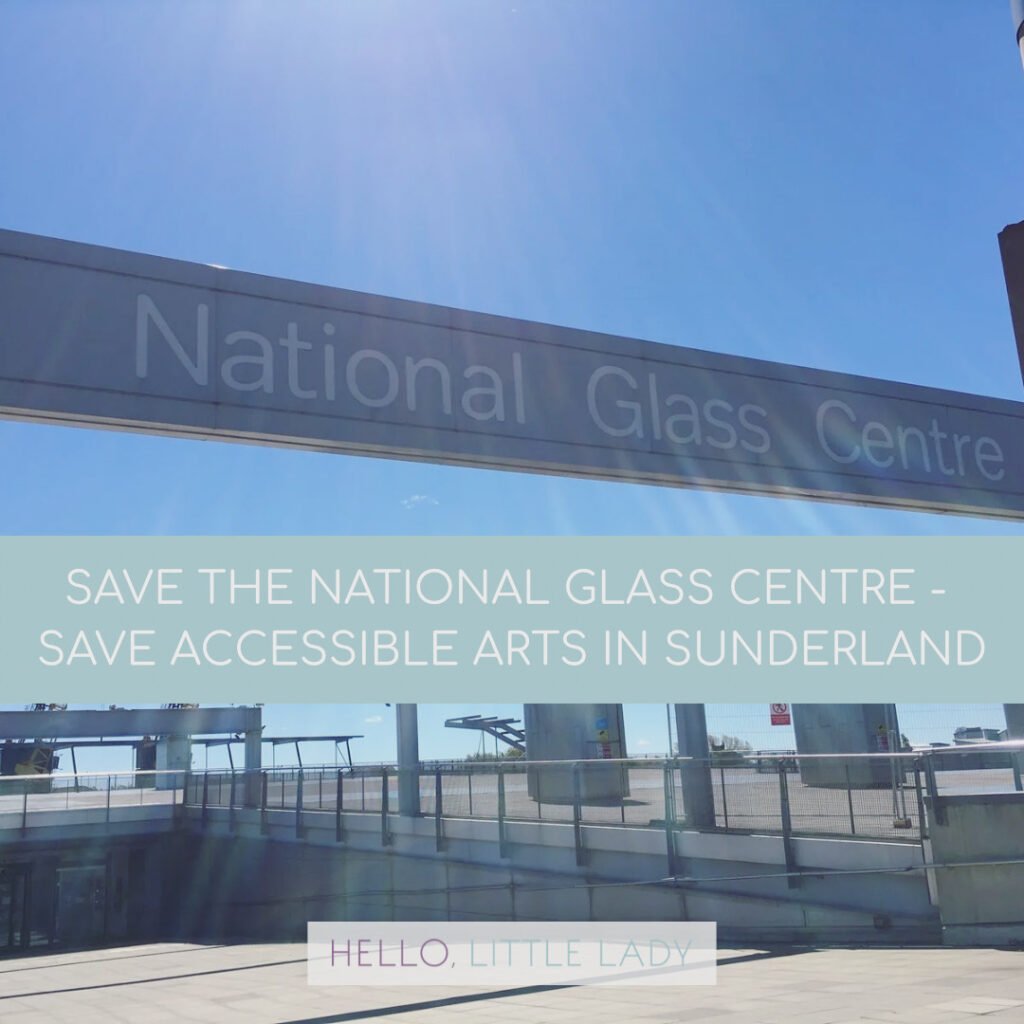
I wrote this blog post back in June 2025. I’ve been hesitant to publish it – for fear of speaking out and facing professional reprisals. Yet, as the closing date for the venue looms ever nearer, adding my own voice and an alternative view as to why the National Glass Centre must be saved is also pertinent.
The University of Sunderland announced the closure of the National Glass Centre (NGC) in 2023, citing the prohibitive costs required to restore the imposing building that has stood proud since its opening in 1998. Meaning glass-making, which has a long and proud heritage on the banks of the River Wear, will disappear from where it first began centuries ago.
While the loss of such an industry is catastrophic, I would like to add that it’s not only the disappearance of glass-making that will feel its impact once the venue is forced to close its doors for good.
Personally and professionally, it will be felt as a creative practitioner, as a parent, and as a disabled resident in Sunderland.
A Tourist Venue For All
The National Glass Centre caters for tourists, school visits, family outings on wintery days, and a place to take the kids to occupy them over the summer holidays. The venue was even used for a cabinet meeting by the government to celebrate Brexit.
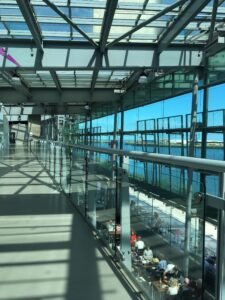
The building is a light and airy place to meet for lunch or a cuppa; the space cultivates artistic practice and communities. The view over the River Wear – stunning.
Only a couple of weeks ago (May ’25 half-term), my daughter and I took a Bank Holiday stroll around the many exhibitions and the shop. The building was busy. The cafe/restaurant is full. The quality of the exhibitions in the building is on par with The Baltic and MIMA.
The NGC car park was the first place that I arrived at for my first introduction to the University’s St. Peter’s campus.
Unbeknownst to me at the time, this wonderful, imposing building would become the place to show to visiting relatives, a place to take my daughter for countless creative activities and marbles from the shop. A place to catch up with friends, family, and to network, as we’d gaze over at the huge ships docked in port opposite.
The NGC’s Impact On Sunderland Creative Industries and Communities
Professionally, its impact on the Sunderland creative industries also cannot be understated.
The place houses glass artists and, more recently, Sunderland’s contemporary art offering, the Northern Gallery of Contemporary Art (NGCA), which was relocated from its city centre location in 2018.
It’s a place to see world-class contemporary glass artists’ exhibitions, and those who want to learn about glassmaking can see this firsthand with the glass-blowing demonstrations. It has shown major exhibitions like Antony Gormley’s, ‘Field for the British Isles’ (2021).
Over the years, the university has played a vital role in the development of visual and community arts in the city alongside Sunderland Culture.
Together they developed and nurtured artists, creatives and community art practitioners. Funding artistic practice that saw local artists facilitating and running participatory workshops in the venue and around the city.
The impact of this withdrawal of support by the University in this way has barely, if at all, been accounted for.
The University’s role has not only been about maintaining the physical building of the NGC, but also the creative communities built in a safe and accessible space.
Sunderland City Cultural Development Sets A Pace – leaving visual artists and heritage arts behind?
There has been a huge investment in developing the cultural quarter in the city centre at Keel Square. The focus is on music and theatre with venues like the Fire Station, The Empire Theatre and an array of pubs and bars. There is also the eagerly awaited opening of the Culture House – a new library space.
There has been £5 million allocated for the new Glassworks centre based in Sunniside. Yet, it is a much smaller, older, and, I worry, an inaccessible building. Likely to see listed building protections trump accessibility needs protections, as I have witnessed with other buildings given over to art studios in the city, which are also prohibitively expensive.
However, visual and glass arts appear to have all but been forgotten by the cultural planners of the City, or what feels like an afterthought at best.
Losing a space to develop my creative practice and network
And this is the crux of the sadness for me as an artist and as a disabled creative.
On my own professional path, the NGC is where I began my journey as a creative practitioner and artist in 2017, thanks to the encouragement of the monthly meetings for participatory artists.
The place I looked to for opportunities, to build my professional network, and that is accessible to me as a disabled creative practitioner, is being taken away.
It is one of the few spaces in the city where I feel safe as a person with Dwarfism.
It is also one of the few public buildings that is truly accessible… and I don’t mean it has a working lift.
In a world that is increasingly turning over city centre spaces to pedestrianisation, parking at public venues is becoming increasingly hard to find as a disabled person.
This might not seem an important reason for some to save the National Glass Centre in the grand scheme of things, but hear me out.
At the new cultural quarter in Sunderland city centre, there is a distinct lack of disabled parking for the cultural venues that have popped up on Keel Square or access to nearby public transport.
There is one row of disabled parking adjacent to The Empire Theatre and The Fire Station.
Disabled people are having to fight to be able to get close to the array of new and established cultural venues and the Bridges shopping centre. In context, I have no clue how I am going to be able to get near the new Culture House library to do something like return my library with relative ease.
St Mary’s car park is a heck of a distance to travel as a disabled person, while navigating one of the main, busiest, dual carriageways in the city centre.
And this is why it’s important to maintain accessible cultural venues in the city for disabled people
Access isn’t just about inside the building for a disabled person or having step-free access with a working lift. It’s about whether we can get there in the first place.
And something as basic as this looks like it has not even been considered by those involved in the recent cultural development of the city, and hints at the wider lack of disability inclusion, as ever, in rooms where such decisions are made.
Whereas, with the existing provision – the NGC – you can park at the top of the building and down by the side. This means that the building is easier and safer to access as a disabled person.
You’re not navigating dual carriageways. You don’t have the stress of finding disabled parking or drop kerbs. In my case, being able to park close to a venue, like the NGC, reduces the chances of experiencing negative, abusive attention as a dwarf person.
I leave you with one last thought…
I worried about publishing this piece for a long time, for fear of being blacklisted in the city as a creative professional. Yet, it is important to see a range of voices and perspectives on why the National Glass Centre is important to the city of Sunderland.
The campaigners who have tirelessly campaigned against the building’s closure are to be commended. I’m glad to see Sunderland Labour’s U-turn in asking for the NGC closure to be halted, and the most recent The Guardian article and local BBC and ITV News teams are adding to the momentum of the campaign. I hope this blog post goes some small way to help.
The National Glass Centre is a unique, cultural, architectural, and accessible gem. I would urge the powers that be, whether that is the university, Sunderland Council or other investors, to do all they can to save this space that adds hugely to the city’s cultural landscape.
I understand that times change. Industries, priorities and markets change and evolve, but it must not be at the expense and cost to communities – residential and professional – and yes, disabled.
Please, Save the National Glass Centre.
Steph
Resources:
- Save the National Glass Centre campaign website
- Sign the Petition
- Save the National Glass Centre – Facebook Group
- Why is the National Glass Centre closing?
- Sir Antony Gormley’s 40,000 figures coming to Sunderland
- The Guardian – Shattered dreams: Why the battle for Sunderland’s glass centre has turned into a political flashpoint
- Labour group U-turns over glass centre closure